
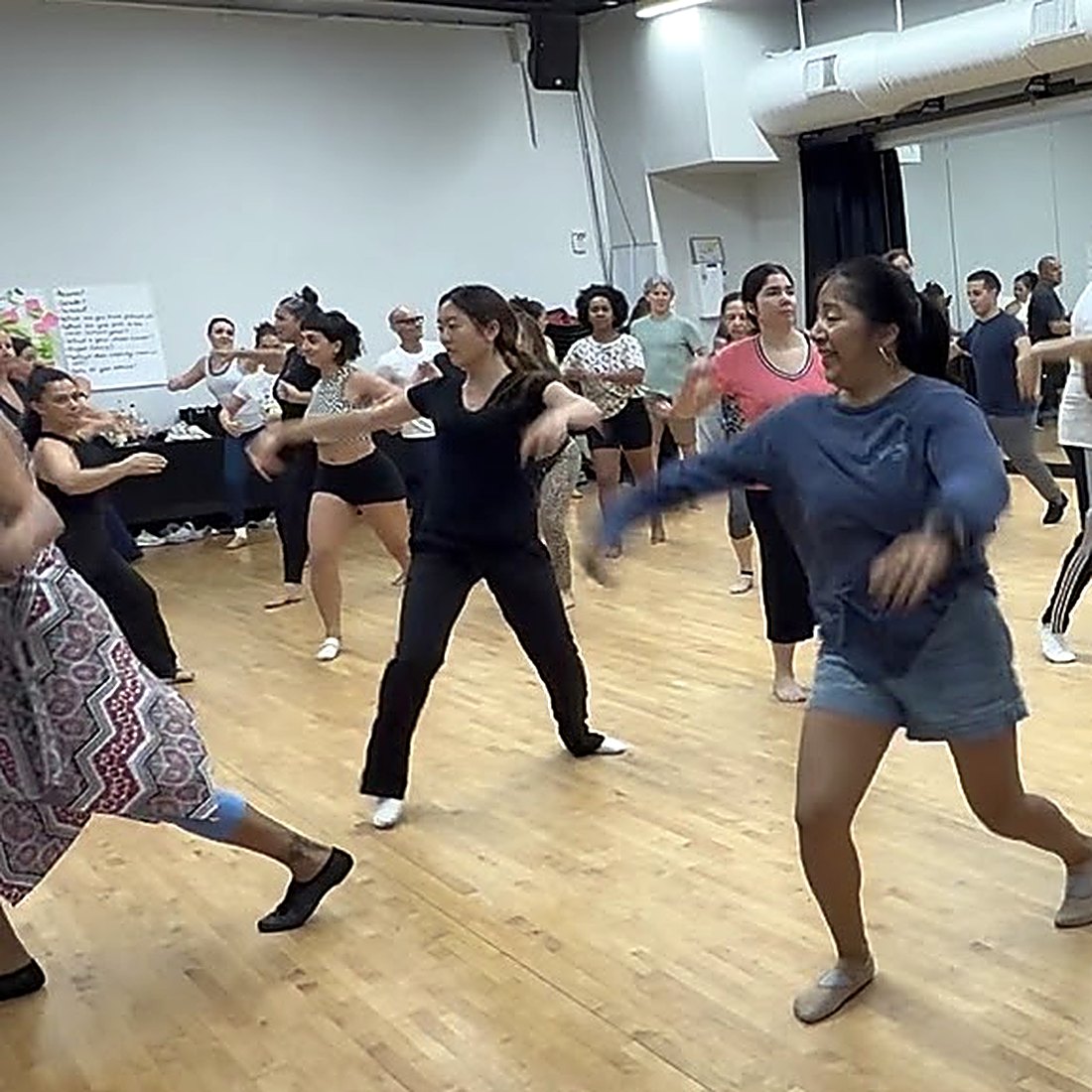
Today, I learned about Pilón, a Cuban dance inspired by the action of pounding coffee or grain in a mortar, and Molienda de Café, which imitates the process of grinding coffee, from Ms. Marisol Blanco. Ms. Marisol demonstrated how movements rooted in daily labor were transformed into dance, preserving cultural experiences through rhythm and movement. I was fascinated by how ordinary activities could become artistic expression and cultural memory.
One of the most challenging techniques we practiced was the Kah-Chang footwork used in Molienda de Café. The "Kah" involved sliding the foot outward while keeping it connected to the floor, while the "Chang" required a subtle weight transfer and hip drop. Although the movement appeared simple, it demanded control, coordination, and groundedness. I quickly realized that Afro-Cuban dance requires a deep awareness of rhythm and weight placement.
What stood out most was Marisol's teaching philosophy. Her approach reinforced one of the central ideas of my fellowship research: movement can serve as a form of cultural memory. Through dances like Pilón and Molienda de Café, stories of labor, community, and daily life continue to be remembered and shared across generations.
This class deepened my appreciation for the richness of Afro-Cuban dance and showed me how traditions can be preserved while adapting to new cultural contexts. I left with a greater understanding of how movement carries history and how dance can connect people to experiences far beyond their own.
Lastly, I just want to thank all the dancers for creating such a fun and respectful environment. :)
Ordinary activities could become artistic expression and cultural memory.