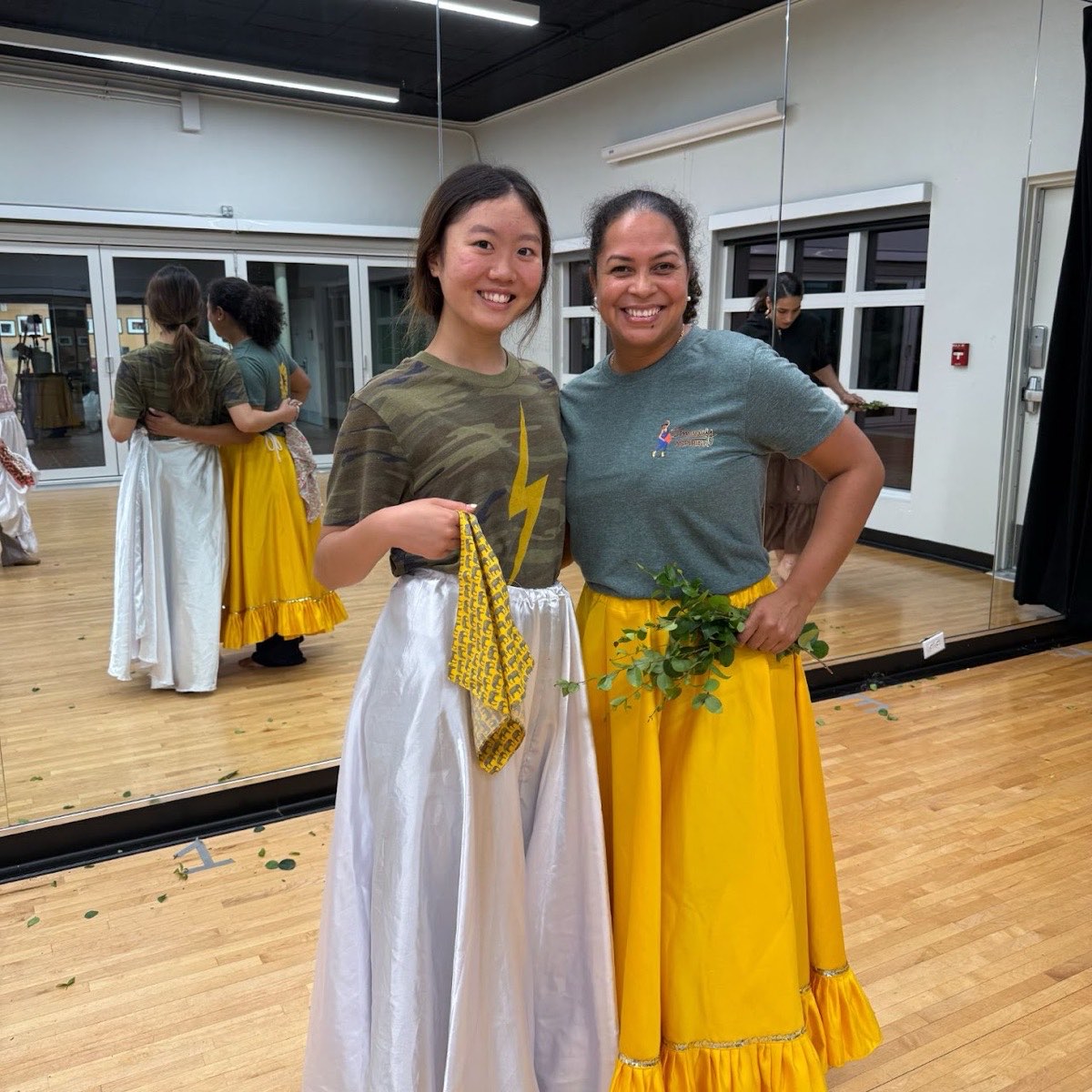
Ms. Marisol Blanco welcomed a guest teacher who led the class entirely in Spanish. Although she spoke quickly, I could understand most of it (thanks to all my Harvard-Westlake Spanish teachers, let's go! 😄). Additionally, I learned how much can be communicated through movement, demonstration, rhythm, and expression.
The lesson focused on the relationship between dance, nature, and cleansing. Using two handkerchiefs to represent leaves and branches, the teacher demonstrated movements that symbolized limpio, which means the cleansing of the body, mind, and spirit. She explained through movement that trees, plants, and nature are not separate from us; instead, dancers embody them through their arms, gestures, and presence. As we moved the handkerchiefs through the air, they became extensions of branches and leaves, transforming the dance into a reflection of the natural world. The teachers actually used leaves and branches from trees at the Koubek Center during the dance.
Dance can communicate across linguistic and cultural boundaries.
Sá-yá! Call, Response, and Rhythm
One of the most striking moments was the last half of class, where we lifted our skirts and shouted "Sá-yá!" The chant energized the room and connected everyone through a shared rhythm, and I could not hide the smile on my face. The teacher also used playful calls of "Mucho Muchacho" and demonstrated the Afro-Cuban tradition of call-and-response, where leaders and participants communicate through voice, music, and movement. At times, she used wooden sticks to create rhythms before the music began, emphasizing the close relationship between percussion and dance.
My biggest takeaway was that Afro-Cuban dance is about much more than learning choreography. It is a way of expressing cultural values, connecting with community, and building relationships with nature. Even without fully understanding the language, because she spoke so fast, I was able to understand the meaning through the movement itself. This experience reminded me that dance can communicate across linguistic and cultural boundaries.
I am deeply grateful to Ms. Marisol Blanco and the guest teacher for sharing their knowledge, energy, and cultural traditions with such generosity. Thank you for creating a welcoming space where students like me can learn not only steps, but also the history, symbolism, and spirit behind the movement.