
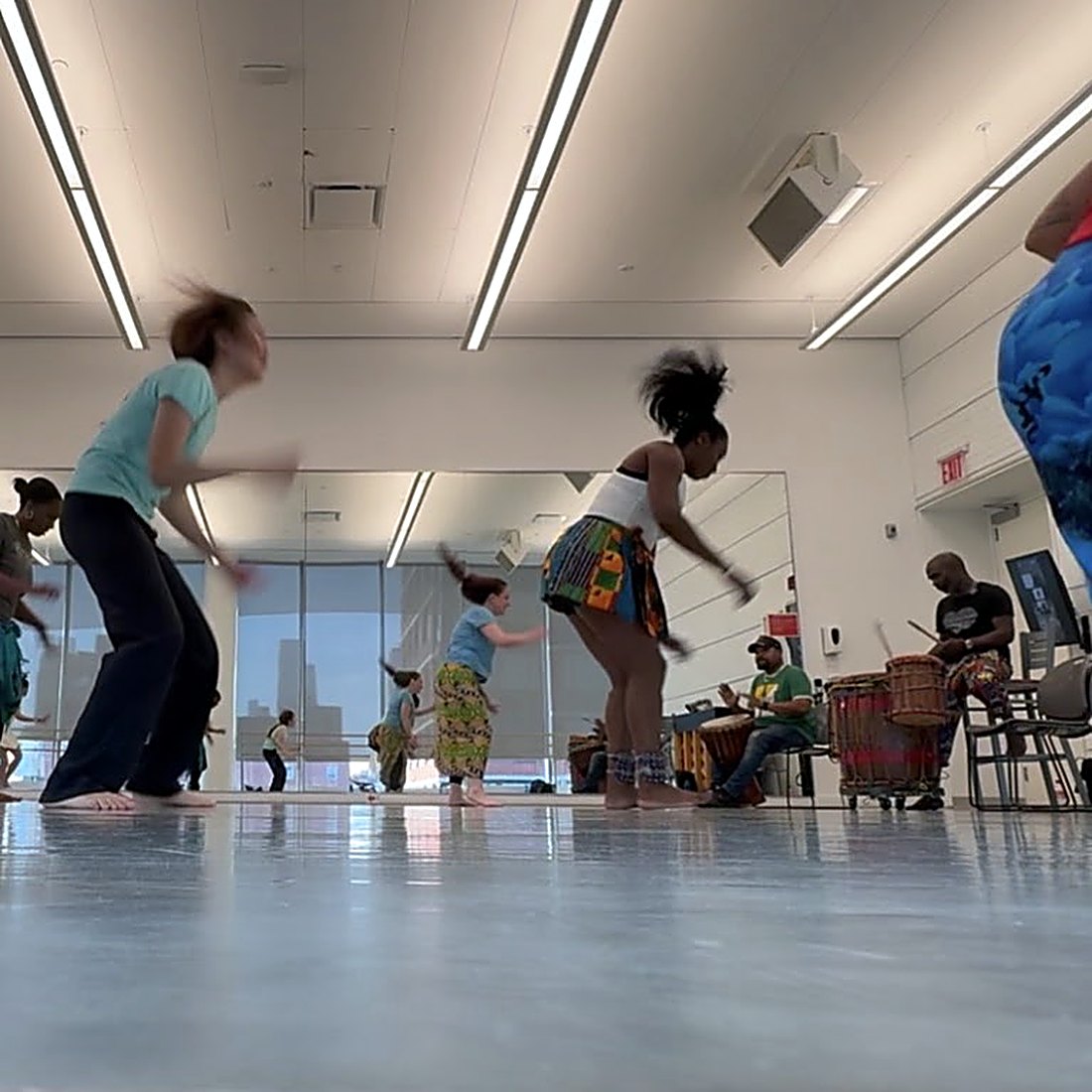
Today was especially meaningful because my Harvard-Westlake teachers, Señora Escarpeta-García (Spanish Literature) and Señor García (English), joined me in class. Further, today's class builds on my earlier West African dance classes at Ailey Extension with Maguette Camara, teaching me the West African foundations of many Afro-Cuban dance traditions.
One of my favorite things about Camara's classes is the live drumming. Rather than serving as background music, the drummers and dancers communicate through rhythm. Every movement responds to the changing beats, demonstrating that music and dance are inseparable. Watching this relationship unfold has taught me that dance is not simply choreography but also a living cultural practice that preserves history, values, and community through embodied movement.
At the same time, I observed how these traditions continue to adapt within the United States. The studio brought together people of different ages, ethnicities, languages, and dance backgrounds, all learning from the same cultural tradition with curiosity and respect. While the dance remains rooted in its African heritage, it also continues to evolve as it is shared within America's diverse, multicultural communities. Rather than diminishing its cultural significance, this exchange creates opportunities for greater understanding while honoring the tradition's origins.
As I prepare for Phase 2 of my Harvard-Westlake Junior Fellowship in Miami, this experience reinforced one of the central themes of my research: movement is cultural memory. Through live drumming, communal participation, and embodied storytelling, dance preserves history while continuing to adapt across generations, cultures, and communities throughout the African diaspora and the multicultural landscape of the United States.
Rather than serving as background music, the drummers and dancers communicate through rhythm.